Higher Rates, More Room to Negotiate?
Finding Opportunity When Rising Interest Rates Slow the Housing Market.
By Russell Chandler | Principal Agent – Associate Broker at Redfin
Buying a home often brings two questions together: Does this particular property fit my needs, and do the price and terms make sense? Market conditions can affect how much room there is to negotiate. The result still depends on the property, the seller, the financing, and the buyer’s own priorities.
When mortgage rates rise sharply, some buyers pause to reassess their budgets. If competition eases, prepared buyers may find more room to negotiate price, seller-paid closing costs, or other terms. Markets ebb and flow, but every property is different: a higher rate does not automatically mean a better deal.
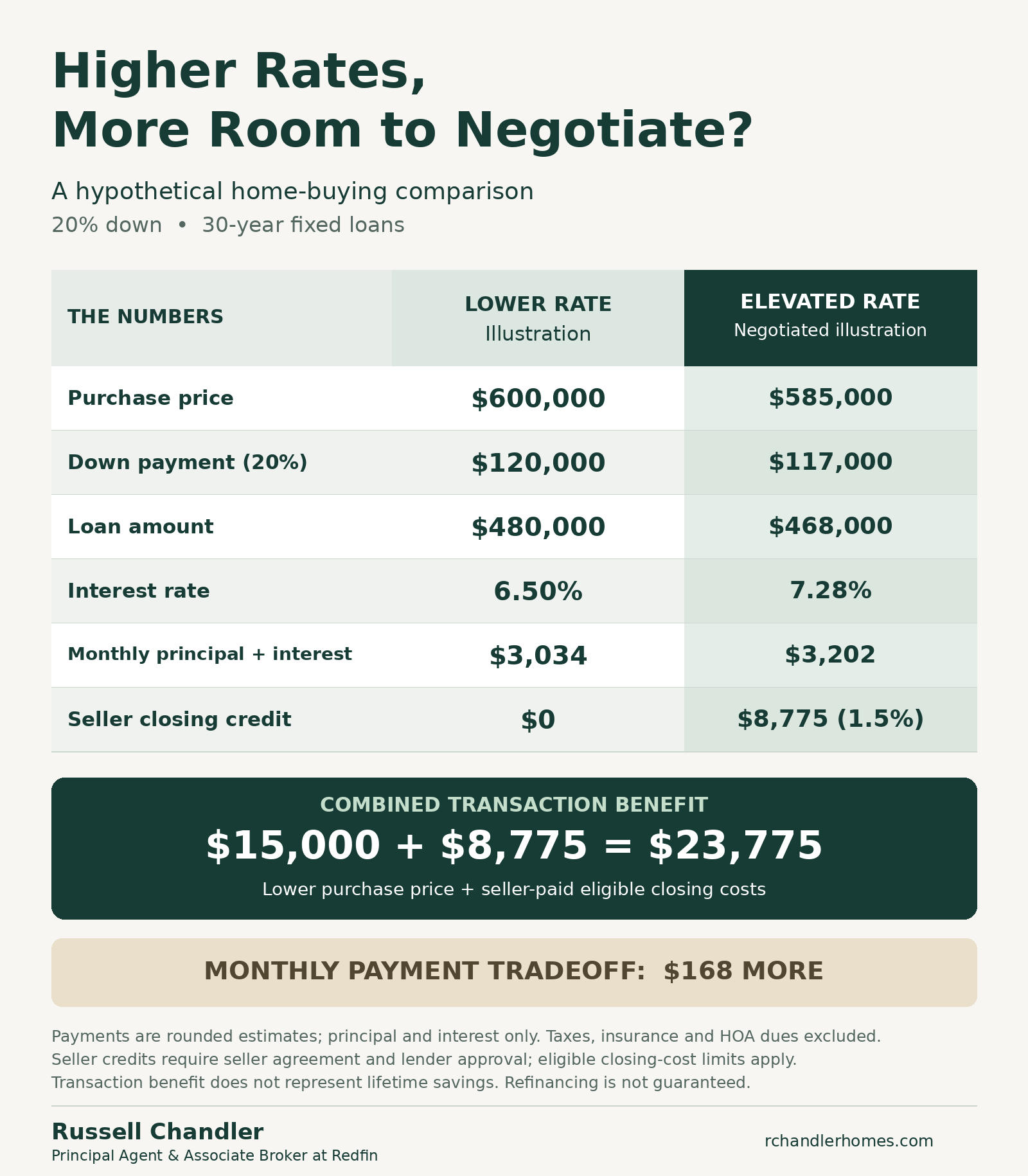
A side-by-side look at the numbers
Here is a hypothetical comparison for the same $600,000 listing. Both examples use 20% down and a 30-year fixed-rate loan. The lower-rate illustration uses 6.5%; the elevated-rate illustration uses 7.28% with a negotiated price and seller credit. Neither rate is a loan quote.
Lower-rate illustration
Purchase price: $600,000
20% down payment: $120,000; loan amount: $480,000
30-year fixed rate: 6.50%
Estimated monthly principal and interest: $3,034
Seller-paid closing credit: $0
Elevated-rate, negotiated illustration
Purchase price: $585,000 — $15,000 less
20% down payment: $117,000; loan amount: $468,000
30-year fixed rate: 7.28%
Estimated monthly principal and interest: $3,202 — about $168 more per month
Seller-paid closing credit: 1.50% of $585,000 = $8,775
Transaction benefit: $23,775
$15,000 price reduction + $8,775 seller credit = $23,775 combined transaction benefit.
Price minus credit, for comparison only: $576,225
Less cash needed at closing: $11,775, assuming equal other closing costs and full use of the credit
*The price-minus-credit figure is a comparison measure, not the contract price, loan amount, or total ownership cost. The actual purchase price remains $585,000; the credit offsets eligible closing costs.
**Assumes identical other closing costs and full use of the seller credit. The $3,000 smaller down payment is part of the price reduction, not additional savings.
What the transaction benefit means
The negotiated illustration includes a seller contribution of 1.5% of the $585,000 purchase price, or $8,775, toward eligible closing costs and prepaids. Credits require seller agreement and lender approval and cannot exceed program limits or actual eligible costs. They are not cash paid directly to the buyer. This example applies the credit to closing costs and does not model a rate buydown.
The $15,000 price reduction plus the $8,775 closing-cost credit creates a combined $23,775 transaction benefit. With 20% down, the price reduction lowers the down payment by $3,000 and the starting loan by $12,000. If other closing costs were identical and the full credit were usable, cash needed at closing would be $11,775 lower.
Despite the smaller loan, the elevated-rate example has a principal-and-interest payment about $168 higher per month, or about $2,018 more per year using unrounded payments. The lower price and credit are a negotiating advantage, not proof of lower overall ownership costs. The full comparison depends on how long the loan is held, interest paid, the remaining loan balance, and any refinancing costs.
These figures are illustrations, not quotes or predictions. Payments exclude property taxes, homeowners insurance, HOA or condo dues, utilities, maintenance, and other costs. Actual terms depend on financing, property, lender rules, and seller agreement.
Rates can change. Your budget still matters.
Mortgage rates change over time, and a buyer may have an opportunity to refinance if rates fall. But history does not establish a deadline for lower rates. With these 30-year fixed-rate loans, principal and interest stay fixed unless the loan is changed, such as through refinancing. Taxes and insurance can change separately.
A future refinance depends on qualification, property value, available terms, and costs. It should be evaluated on its own merits. The purchase needs to fit your budget with the financing available today.
The life ahead
If you plan to live in the home, the market snapshot may feel less important with time. Fifteen years from now, you may remember the routines you built, the places you came to know, and how it felt to make the home your own. The right choice is personal: it should fit your finances, needs, and plans, including the way you want to spend your days.
The numbers matter. So does the life you hope to build there. If you’re considering a purchase in Maryland or Washington, DC, I’m happy to walk through the property, terms, and numbers with you so you can decide what fits your situation.
Book a consultation · Call Russell: (240) 988-7609
Tell me what you’re looking for · Explore Rockville real estate · Explore Montgomery County real estate · Explore Silver Spring real estate